
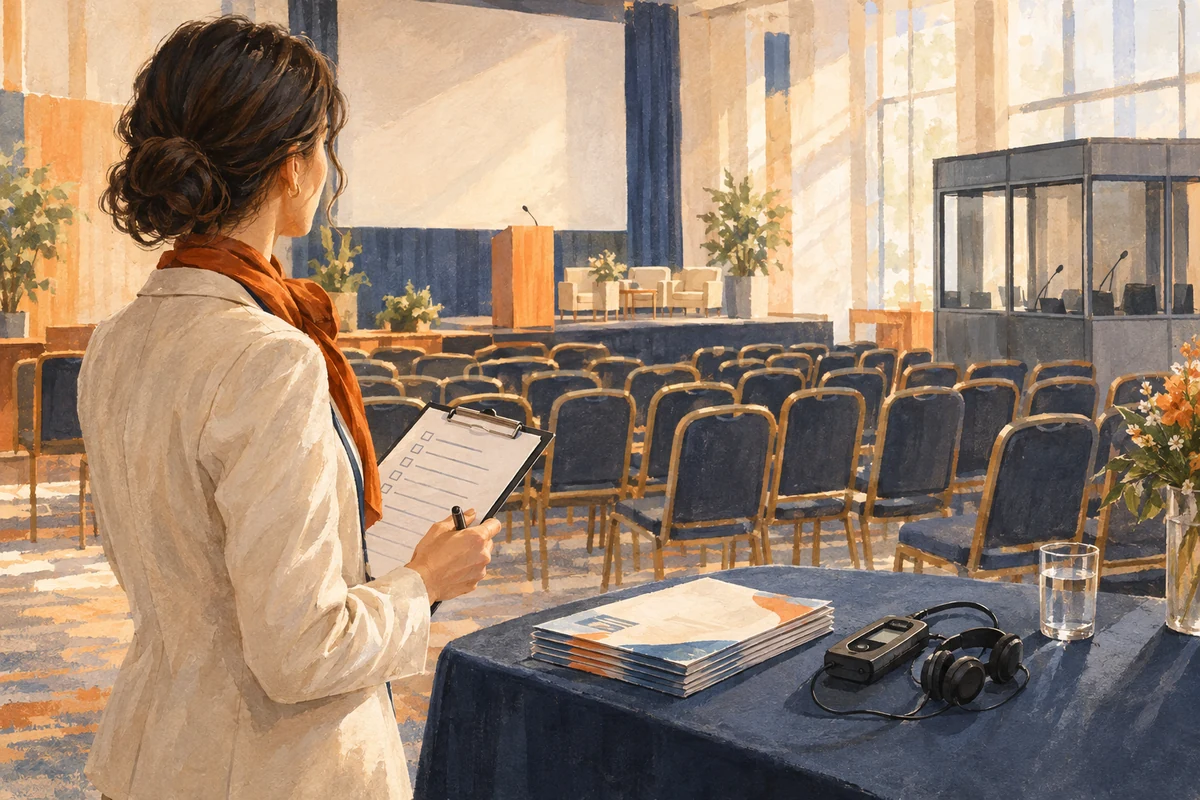
A week before the conference, the organizer discovers that the interpreting booth does not fit between the stage and the first row of seats, and the speaker sent the slides late the night before - forty slides full of tables and abbreviations nobody had time to review. The equipment is booked and paid for, the interpreters are confirmed. The budget is fine, and the interpreting on site can still fall apart.
Simultaneous interpreting as a format was invented at the Nuremberg trials of 1945-1946, because consecutive interpreting stretched the hearings out several times over and there was no time to spare. The technology has changed since then, but the main condition has not: interpreting falls apart not where the budget runs out, but where the organizer failed to prepare the venue and the materials. Money decides whether you hire a team of interpreters; preparation decides whether that team can do the job you paid for.
Here is the order of steps: what to decide a month out, what to hand the interpreters two weeks out, what to check technically a week before the event, and how to run the program on the day itself so the interpreting does not let you down.
Timeline checklist: who is responsible and when
This is a plan you can print out. If there is no time to read the whole article, the table below is enough to keep the key steps in view.
| Deadline | What to do | Who is responsible |
|---|---|---|
| One month out | Decide on the languages, the interpreting format and the number of participants; book the interpreters and the equipment | Event organizer |
| Two weeks out | Hand over the program, the presentations, the list of names and titles, and a glossary of industry abbreviations | Organizer - to the interpreting coordinator |
| One week out | Agree on the setup, power supply and booth location; check the venue sound | Technical contractor and venue |
| The day before | Run an on-site rehearsal, check the receiver channels, brief the speakers | Interpreting coordinator and organizer |
| On the day of the event | Keep the coordinator in touch with the interpreters, report any changes to the schedule right away | Organizer and interpreting coordinator |
Each point is explained below - why it matters and what happens if the step gets skipped.
One month out: languages, format, booking the team
The first decision is not the budget but the format. Simultaneous interpreting is needed when the program is packed and there is no room for pauses to translate: a conference, a forum, a panel discussion. Consecutive interpreting works for negotiations and small meetings, where a pause after each phrase is not a problem. For two or three foreign guests in the room, whispered interpreting (chuchotage) is often enough - the interpreter translates quietly alongside them, with no booth and no equipment.
The format determines everything that follows: the number of languages, whether a booth is needed, how many receivers to order. This is also when the team gets booked: finding interpreters and equipment need to happen early, not once the program is finalized. During peak season - late May, September, December - available interpreters with the right subject expertise may simply run out.
Bottom line. Book the team and the equipment as soon as the dates and the number of participants are known, even if the program is not ready yet. The program and materials can follow later, but you cannot find an available interpreter for the right language and subject at the last minute.
Two weeks out: materials the interpreter cannot work without
An interpreter does not walk into the booth cold - they prepare using materials the client provides. The minimum set:
- the event program with the exact order of talks and timing;
- the speakers' presentations and handouts - the final version, not a draft;
- a list of participants with names, titles and the exact spelling of company names;
- a glossary of industry abbreviations and terms that will come up on stage.
Send this two weeks ahead, not two days ahead. The interpreter does not memorize the materials - they note down terms, check names and titles, and work out the context behind an unfamiliar abbreviation. This work happens before the event: there is no time for it in the booth.
What happens when the materials are not provided
Without the program, the interpreter does not always know where a talk ends and a question from the floor begins, and the first few phrases come out off the mark. Without the list of participants, names and titles get mixed up on stage - a mistake the whole room notices. Without a glossary of abbreviations such as EBITDA, ISO, KPI or industry terms, the interpreter loses seconds working out what the abbreviation means, and misses the speaker's next phrase in the process.
None of these mistakes has anything to do with the interpreter's skill. An interpreter works with whatever was provided in advance - and the quality of the interpreting on stage depends directly on the quality of the materials received two weeks before it.
One week out: the technical side at the venue
Alongside the materials, the technical side needs settling - where the booth will stand, where the power will come from, and what to prepare in the room. For an organizer handling simultaneous interpreting for the first time, it helps to check against a basic set of requirements.
| Parameter | Requirement |
|---|---|
| Booth location | Direct line of sight to the stage and the room, a level surface, access for setup 2-3 hours before the start |
| Power supply | A dedicated line for the booth and the transmitter - not on the same circuit as the stage lighting |
| Line of sight for the infrared signal | Columns, balconies and partitions must not block the beam between the emitters and the listeners |
| Room sound | A clean feed from the sound engineer's mixer into the booth, not a microphone pointed at the room |
| Receiver distribution | A spot near the entrance for handing out and collecting the headphones, with a dedicated person on distribution |
If you are using an infrared transmission system (Bosch Integrus, for example), it has a property that matters for placement: the signal travels on a direct infrared beam and does not pass through walls or columns. The same property keeps the conversation from being intercepted outside the room, but it requires the booth, the emitters and the listening area to be in direct line of sight of each other.
The requirements for the booths themselves are set out in international standards: since 2024, ISO 17651-1 has applied to fixed booths and ISO 17651-2 to mobile ones, replacing the withdrawn ISO 2603:2016. Some venues and contractors still refer to the old standard number out of habit, but the substance of the requirements - sound insulation, ventilation, view of the stage - has not changed. The full equipment sets are described in the simultaneous interpreting equipment section, and setup and transmission are covered on the technical support page.
The day before: rehearsal, channel checks, briefing the speakers
The day before the event, or the morning of it - three short steps that remove almost every technical surprise.
- On-site rehearsal. The interpreters go into the booth and check the view of the stage and the audio - in person, not from a description.
- Channel check. A technician checks every receiver and channel, including the backups - in case a microphone on stage fails.
- Briefing the speakers. The organizer gives the speakers a short reminder that simultaneous interpreting is running in the room and why that changes how to speak from the stage - more on this below.
If part of the audience is joining remotely, this is also when the audio feed for online interpreting gets checked - on a separate channel from the room, so a failure in one does not affect the other.
On the day of the event: how a speaker should talk for accurate interpreting
An interpreter does not translate word by word - they build a sentence in the other language while listening to the next one. A speaker's delivery affects the final interpreting more than it seems.
- Pace. A fast, monotonous pace leaves no room for compression - the technique interpreters use to shorten a sentence while keeping its meaning. It matters especially when interpreting from Russian: Russian text runs longer than English on average.
- Reading from a script. Written text is read faster than it is spoken freely, without the intonation pauses an interpreter relies on to tell where one thought ends. It is better to hand this kind of talk to the interpreter in advance, not just deliver it on stage.
- Jokes and idioms. Wordplay and cultural references rarely translate literally - the interpreter swaps in an equivalent in meaning within seconds, and the result does not always match the original joke. That is a feature of the work, not a flaw in the interpreting.
- Abbreviations and numbers. These are the first things lost when the interpreter is under heavy load - see the next paragraph on rotating in the booth.
A separate point about team composition. Interpreters in the booth always work in pairs and rotate every 20-30 minutes: that is the limit beyond which accuracy drops, and numbers and proper names are the first things lost. If the program has one speaker talking for an hour straight with no break, this is worth factoring into the schedule - not because the interpreter gets tired, but because that is how simultaneous interpreting works as a task.
If the program changes at the last minute
Plans change: a speaker runs late, an unplanned talk gets added, a discussion runs over. One simple rule applies here - tell the interpreting coordinator about any change to the program as soon as it is known, not after the fact.
If an unplanned speaker takes the stage, the interpreter has seconds to grasp the topic and adjust - without a name, a title and a subject, it will show in the very first phrases of the interpreting. If a talk is cancelled, a quick message saves the whole team time.
What to arrange in advance. Appoint one point of contact on each side - the interpreting coordinator and a representative of the organizer - who exchange program updates directly on the day of the event. Information travels faster through one person than through a group chat.
Frequently asked questions
Does the interpreter need to see the room, or can they work from a video feed?
A direct view of the stage from the booth is best: the interpreter picks up gestures, the slides on screen, and the room's reaction. Working from a monitor alone is possible, but accuracy is usually lower, especially if the video quality is not perfect.
How many interpreters are needed for an event with two working languages?
At least four - a pair of interpreters per language for simultaneous interpreting. The rule of rotating every 20-30 minutes applies to each language independently.
Can the materials be sent three days ahead instead of two weeks?
Yes, and that is better than nothing - but the more specialized the subject, the less time remains for preparing the glossary. For a narrow field - medicine, law, oil and gas - two weeks is the necessary minimum, not a buffer.
Who provides the booth - the interpreters or the organizer?
The booth is part of the equipment set, installed by the technical contractor along with the receivers and emitters. The organizer only needs to provide the space and power supply per the requirements in the checklist above.
How many days ahead should the interpreting team be booked?
English - at least a week, rare languages and narrow subjects - at least three to four weeks, and for peak season dates it is best to book as soon as the event date is known.
What to do next
If the interpreting format is already clear, move on to booking: the simultaneous interpreting and equipment pages will help you work out the team and equipment you need. If the format is not chosen yet, start with the types of interpreting page - it explains how simultaneous interpreting differs from consecutive interpreting and whispered interpreting.
Send us the dates, the number of participants and the languages, and we will lay out what you will need and when for your venue. You can get in touch at any stage of preparation, not only once everything is decided.


Comments
No comments yet. Be the first!
Leave a comment