
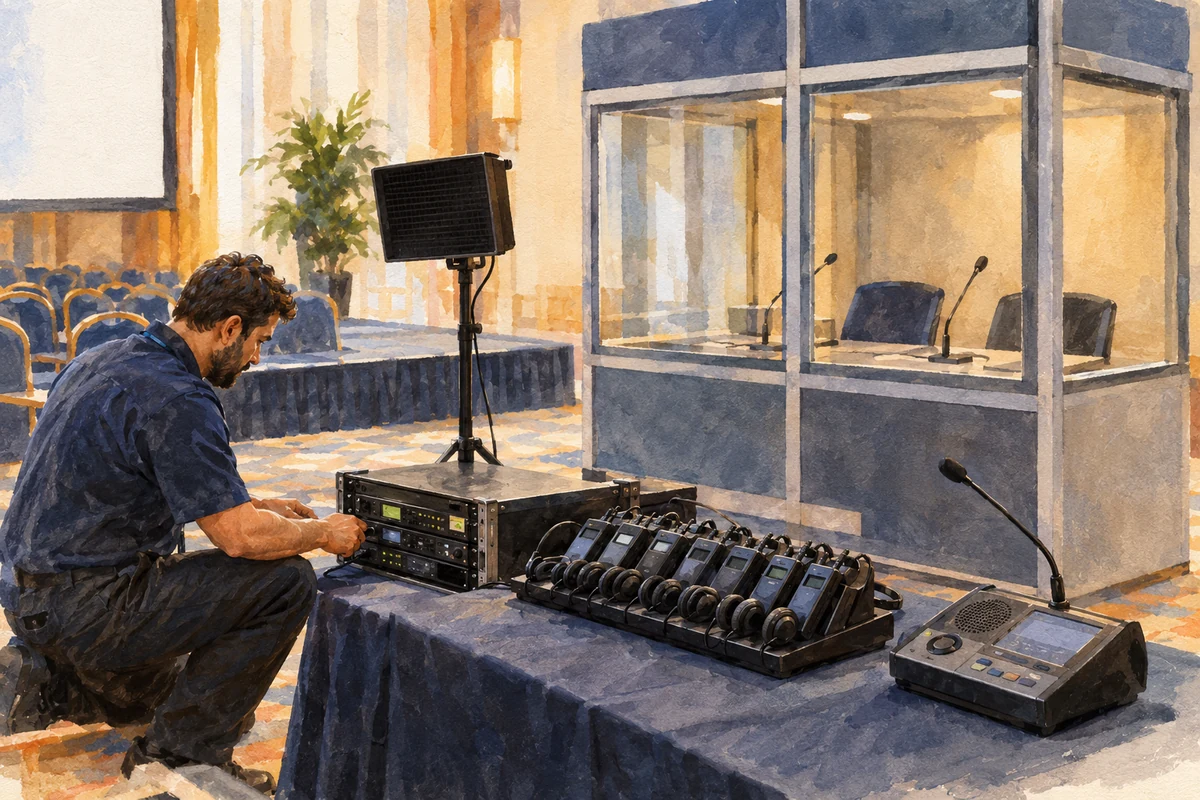
A client contacts a translation agency with a single line: "we need simultaneous interpreting equipment for a conference" - and gets a question back: how many listeners, and how many working languages. That question often catches people off guard. It seems like "equipment" is one thing to order, but in practice the booth, the receivers, and the venue sound system are three separate cost items, priced differently and driven by different parameters of the event.
Below: how a simultaneous interpreting system is built, how infrared kits differ from radio ones, when you can skip the booth, and what to confirm with the vendor in advance. The prices in this article are SINKHRON PLUS's current 2026 rates for renting equipment.
What a Simultaneous Interpreting System Is Made Of
Every simultaneous interpreting system runs on the same chain: sound from the interpreter console goes to a transmitter, the transmitter sends the signal through emitters across the room, and listeners pick it up on receivers with headphones. From there, kits differ in exactly how the signal reaches the receiver, and in whether the interpreter needs a separate booth.
- Interpreting booth. A soundproofed space where the interpreter hears the speaker through headphones and speaks into a microphone, without disturbing the room or being distracted by its noise.
- Interpreter console. The panel inside the booth: language channel switching, volume control, a microphone button.
- Transmitter. Receives the signal from the console and sends it to the emitters across the room.
- Emitters. Infrared panels or radio antennas that distribute the signal to listeners.
- Receivers with headphones. Their number is calculated by the number of listeners, not speakers or interpreters.
The full breakdown for each kit is on the simultaneous interpreting systems page.
Infrared System or Radio System
SINKHRON PLUS kits run on Bosch Integrus infrared technology: the signal travels as a light beam, not a radio wave. That has a practical consequence worth knowing if the event includes confidential discussions: an infrared signal does not pass through walls, and it cannot be picked up from an adjacent room or from outside. A radio system offers no such guarantee - the radio wave spreads beyond the room, and in theory the signal can be caught from outside.
For closed negotiations, board meetings, court hearings, and corporate events with a confidential agenda, an infrared system is a deliberate choice, not just "whatever happens to be available." For open conferences, where nobody is hiding the content of the talks, the difference is not critical, and capacity and the number of languages become the main factors.
What this means in practice. If the event includes a closed session - discussing figures, strategy, or personal data - confirm the system type with the vendor in advance, not on setup day.
How to Size the Right Kit: Listeners and Languages
A kit is chosen by two parameters at once, and both matter equally.
Number of listeners. The room needs exactly that many receivers, plus a small reserve in case a set of headphones turns out faulty or gets lost during a break. Ordering the exact minimum is risky: part of the audience can end up without interpretation right in the middle of the event.
Number of working languages. Each additional language means a separate booth and a separate pair of interpreters, but not a separate set of receivers: the listener just switches the channel on their own receiver. Equipment costs grow far less steeply than the cost of the interpreting team - see the detailed per-language pricing on the simultaneous interpreting page.
| Kit | Capacity | What's Included | Price per Day |
|---|---|---|---|
| Bosch Integrus, Basic | up to 50 people | Transmitter, 50 receivers, on-site technical support | RUB 45,000 |
| Bosch Integrus, Extended | up to 100 people | Transmitter, 100 receivers, additional infrared emitters | RUB 65,000 |
| Bosch Integrus, Premium | over 100 people | Extended kit configured to the venue | RUB 85,000 |
The premium kit's "configured to the venue" wording is not an accident - it has no fixed line-up: a room seating several hundred people and two adjoining rooms linked by a video feed call for different emitter layouts, and each case is worked out individually. This is usually also where the question of accompanying video streaming gets settled - see the technical support page.
Interpreting Booth: Fixed and Portable
A booth is not a generic box - it's a piece of equipment that has to meet soundproofing and ventilation requirements: the interpreter works inside it for hours at a stretch, and there are usually two people in there at once, because simultaneous interpreters switch every 20-30 minutes - holding a high level of accuracy any longer is physically demanding, and numbers and proper names are the first things to slip.
The standards covering booths were recently updated. The former ISO 2603:2016 for fixed booths has been withdrawn; since 2024 it has been replaced by two separate documents: ISO 17651-1:2024 for fixed booths and ISO 17651-2:2024 for portable ones. Part of the market still refers to the old ISO 2603 and to ISO 4043 for portable structures - these are formally outdated numbers, and when requesting a booth it's worth asking the vendor which standard they are working to.
A fixed booth is a permanent structure installed once, in a room designed for conferences. A portable booth is assembled and taken down for each event, which is why it's the one most often used for rental: a demountable unit can be brought into any room, including one never designed for simultaneous interpreting in the first place.
When You Don't Need a Booth: Whisper Sets for Small Groups
A booth isn't always necessary. When there are only a few foreign guests - negotiations, an off-site meeting, accompanying a small delegation - the interpreter can work in chuchotage mode: no booth, quietly speaking the interpretation into a microphone next to the group, while the guests listen through compact receivers. In rental terminology, this is the "whisper set."
The price difference makes the point.
| Kit | Capacity | What's Included | Price per Day |
|---|---|---|---|
| Whisper set, small group | 1-10 people | Transmitter and 10 receivers | RUB 4,000 |
| Whisper set, medium group | up to 25 people | Transmitter and receivers matched to guest count | RUB 6,000 |
| Whisper set, large group | up to 50 people | Transmitter and receivers matched to guest count | RUB 8,000 |
A kit for ten people costs RUB 4,000, while a fixed system for a 50-seat room costs RUB 45,000 - more than eleven times as much. The mistake also happens in reverse: trying to cover a room of fifty listeners with chuchotage, where the interpreter physically cannot reach the back rows, and intelligibility drops along with voice volume. See the whisper set page and the chuchotage service description for details.
Venue Sound: When You Need a Separate Kit
A simultaneous interpreting system does not replace the venue's sound reinforcement - that's separate equipment: speakers, a mixer, and microphones for the presenters. It's needed when the venue has no sound system of its own, or its system isn't rated for the number of guests.
| Kit | Capacity | What's Included | Price per Day |
|---|---|---|---|
| Sound, basic kit | up to 50 people | Speakers, mixer, two wireless microphones | RUB 8,000 |
| Sound, standard kit | - | Speakers, mixer, microphones | RUB 12,000 |
| Sound, professional kit | - | Speakers, mixer, microphones | RUB 18,000 |
If the conference room is rented at a hotel or business center with an in-house sound system, this line usually drops out of the quote - the only thing left to check is that the in-house sound connects to the interpreting system's transmitter without a loss of quality. See the full list on the sound equipment page.
Rent or Buy
For a one-off or infrequent event, renting is almost always the better deal: the kit arrives with a technician responsible for setup, configuration, and running the system throughout the day, and there's no need to store or maintain the equipment between events.
Buying makes sense when simultaneous interpreting is part of permanent infrastructure: the venue has a steady flow of conferences, its own conference room with fixed seating, or the client needs the booth and receivers available any day without coordinating a rental schedule. In that case, budget for more than just the kit itself - maintenance, storage, and the fact that the technology keeps moving forward: equipment bought today may fall behind the models available on the rental market a few years from now.
What to Confirm with the Vendor Before Renting
A list of questions that heads off most surprises on event day.
- The exact number of listeners, and whether there's a reserve of receivers above that number.
- How many working languages, and accordingly how many booths, will be needed.
- Whether confidentiality is required - if so, it means an infrared system, not radio.
- Which booth the room needs: a portable one that can be set up for the specific venue, or whether the venue already has a fixed one.
- Whether the room has its own sound reinforcement or that also needs to be rented.
- Who sets up the equipment and when - if the room is occupied until late the evening before, setup will have to happen early on the morning of the event.
- Whether a technician stays on site for the whole event or only for setup.
Bottom line. All seven points come down to one thing: the vendor needs this information before event day, not while setting up on site. The earlier the number of listeners, the number of languages, and the confidentiality requirements are known, the more precisely the kit is matched, and the lower the risk of running short on receivers or ending up with the wrong type of booth.
Frequently Asked Questions
Is a booth mandatory for simultaneous interpreting?
No, not if the group is small. For two or three foreign guests, or a short meeting, chuchotage is enough: the interpreter works next to the group without a booth. A booth is needed where interpretation is delivered to a large room and the interpreter's voice must not disturb listeners who aren't using headphones.
What's the downside of a radio system versus an infrared one if confidentiality doesn't matter?
Nothing fundamental - for an open event, the difference mainly comes down to which equipment a given vendor happens to have. The confidentiality question only matters where the discussions in the room are closed.
How many receivers should I order if I don't know the exact number of guests?
Go by the guest list or registration numbers, and order the kit sized to the next capacity tier up, not the exact minimum: there's usually nowhere to buy extra receivers on the day of the event.
Is setup included in the rental price?
Kits come with a technician responsible for installation and running the system on site. Non-standard situations - setup the evening before, working across several rooms at once - are discussed separately.
Can I rent the equipment without interpreters?
Yes, equipment rental and interpreting services are priced separately. This is common practice when the client already has their own simultaneous interpreters and just needs the room system.
What to Do Next
To size the right kit, the vendor needs three numbers: the number of listeners, the number of working languages, and the type of venue - a room with fixed seating or a room set up for video streaming. The system type, infrared or radio, and whether a booth is needed follow from that almost automatically.
If the event is already planned, write to us with these parameters - we'll size the kit and send you a quote. If you're still comparing options, start with the event equipment catalog: it lists every kit along with what's included and its capacity.



Comments
No comments yet. Be the first!
Leave a comment