

An organizer costs out a hybrid conference and hits a line item: "receiver rental for 200 people" - then remembers that a third of the audience won't be in the room at all, they'll join from home or the office. Shipping a hundred and fifty headsets for half a full room is overkill, but nobody wants to trust live speech to machine translation either: the subject matter is specialized, and the stakes are money and reputation. Between these two extremes there's a working option - remote simultaneous interpreting (RSI): the same interpreters and the same way of working, but without a physical booth and without renting receivers for anyone listening over the network.
SINKHRON PLUS built its own platform for this, RSI Exchange, and on the site the format as a whole is called online and hybrid interpreting. Here is how it works, both technically and organizationally - and when classic in-room equipment rental is still the right call.
What Is RSI and How It Differs from In-Room Interpreting
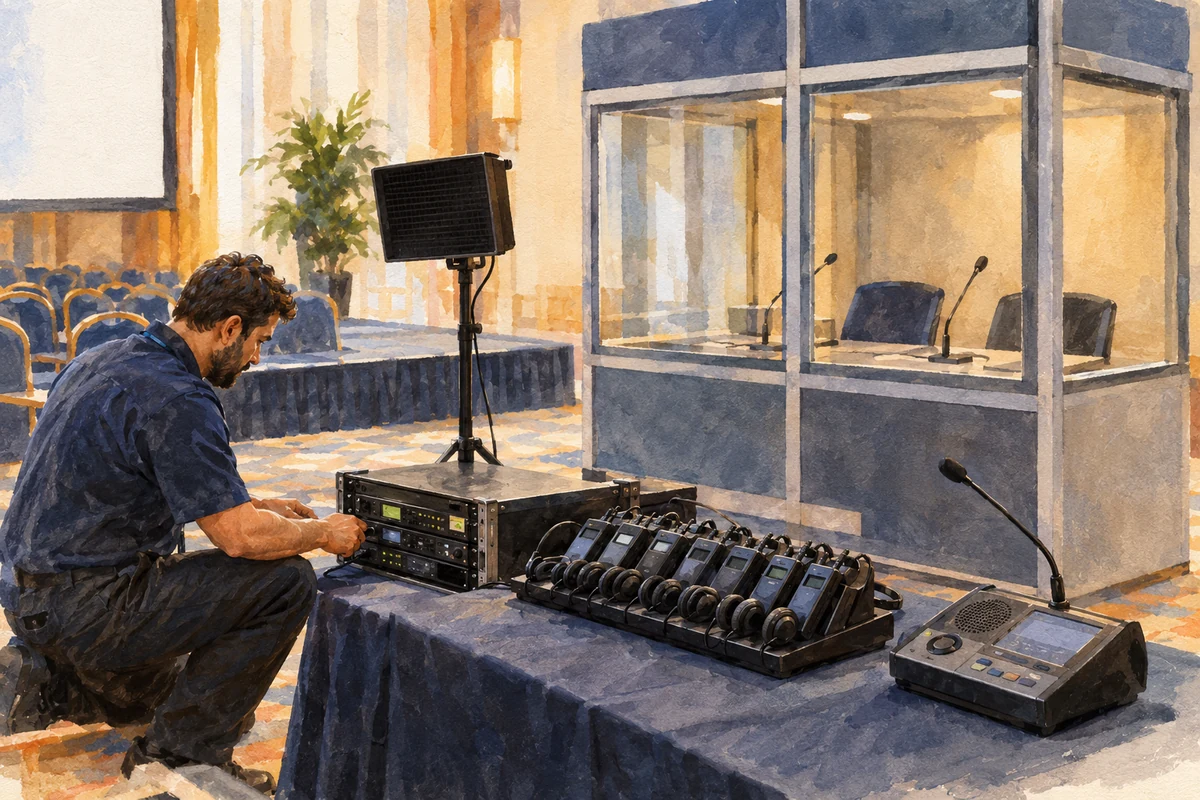
In the room, simultaneous interpreting is tied to a physical location. The interpreter sits in a booth, sound from the stage reaches them by cable or radio channel, and listeners get the interpretation through receivers with headphones - a system such as Bosch Integrus. The booth itself isn't an arbitrary box: fixed booths are built to ISO 17651-1:2024, mobile ones to ISO 17651-2:2024 (these standards replaced the withdrawn ISO 2603:2016 in 2024). The requirements cover soundproofing, sightlines to the stage, and ventilation - the interpreter needs to be physically comfortable for eight hours straight.
With remote simultaneous interpreting (RSI), the interpreter never travels to the venue at all. They connect to a platform - for SINKHRON PLUS, that's RSI Exchange - from anywhere with a reliable internet connection and a quiet room. The booth, in the physical sense, disappears: sound from the stage reaches the interpreter over the network, and the platform delivers the interpreted speech to listeners the same way. What changes is how the sound is delivered, not the interpreter's work itself.
What It Looks Like for a Participant
From a listener's point of view, the main difference is where the sound comes from. The participant opens the platform's mobile app (available on Google Play and the App Store), selects the event, and switches to their language channel - much as they would once have switched a button on a receiver. From there, they listen to the interpretation through their own headphones, plugged into a phone or laptop.
For the organizer, this means there's nothing to hand out and collect at the door - only a link to the app and an event code, sent out in advance. This works both for a fully online event such as a webinar and for the remote portion of a hybrid one.
What Happens on the Interpreters' Side
The format changes where the interpreter works, not the profession itself. In RSI, just as in a booth, interpreters work in pairs and rotate every 20-30 minutes: simultaneous interpreting means listening and speaking at the same time while restructuring each phrase for the grammar of another language, and accuracy under that load drops in a predictable way - numbers and proper names are the first casualties. That's why a pair of interpreters and a rotation schedule stay mandatory regardless of format.
The connection runs through a virtual console - an interface that mirrors the controls of a physical interpreter console: channel switching, volume control, a relay button. If there are more than two working languages and no interpreter pair covers a given pair directly, the interpretation goes through relay - first into a pivot language, then from that language into the rest, exactly as in ordinary multilingual in-room simultaneous interpreting. The interpreter still has to keep compressing each phrase: Russian text tends to run longer than English, and without compression the interpreter starts falling behind the original - this doesn't depend on how the sound is delivered.
Hybrid Format: Part of the Room Offline, Part Online
In a hybrid event, the interpreter still works remotely - their physical presence in the room isn't required for either the in-person or the online part of the audience. The difference lies in how the sound reaches listeners in the room, and here the organizer has two options. One is to give part of the guests the platform's app, so they listen through their own headphones, just like remote participants. The other is to keep physical receivers in the room (Bosch Integrus sets or a whisper tour-guide system from the simultaneous interpreting equipment catalog), feeding them the same interpreted signal. The choice depends on the audience: if guests are willing to use an app on their own phones, receivers aren't needed; if the audience skews older, or the event is a formal protocol occasion where asking people to "use your phone" would be out of place, classic receivers are the safer bet.
In both cases, the technical side in the room matters: clean sound from the stage has to reach the interpreter without distortion, and the interpreted signal has to return to the room without delays or dropouts. That's a separate task, handled on site by a technical specialist rather than by the interpreter. More on this kind of support on the technical support page.
What the Venue and Organizer Need to Provide
Three things determine whether remote interpreting will work.
- Clean sound from the podium. The interpreter needs a feed from the mixer or the speaker's wireless microphone, not a recording of room noise picked up by some random microphone on stage. If the venue has no line output from the sound console, that's worth discussing in advance - this is another place where technical support comes in useful.
- Stable internet, not shared guest wifi. The point where the sound feed originates, and the technical specialist's workstation, are best connected by cable or a dedicated channel, rather than sharing bandwidth with a hundred smartphones in the room.
- A test run before the event. Checking channels, sound quality, and interpreter connections takes time, and doing it on the day of the event, an hour before it starts, is too late: a problem is much easier to find and fix the day before.
Why Channel Stability Matters More Than Speed
Organizers usually ask about internet speed - but for live simultaneous interpreting, what matters more than megabits is the absence of dropouts and latency spikes. A listener will notice a single short break in the connection mid-sentence right away, and a "fast but unstable" channel produces exactly that kind of break. A steady connection, even a slower one, works better than a fast but unstable one.
Bottom line. For a venue with unpredictable internet - an exhibition hall, a remote location, an overloaded conference-center wifi network - build in a backup channel: a second connection point, independent of the main one, for example a mobile modem. That's cheaper than losing the interpretation halfway through the event.
The Economics: What Drops Out of the Budget and What Stays
Interpreters' work in the remote format costs the same as it does in the room: the rate depends on the language and the shift length, not on how the sound is delivered. Simultaneous interpreting is still billed in shifts of up to 4 or up to 8 hours.
| Language | Shift up to 4 hours | Shift up to 8 hours |
|---|---|---|
| English, simultaneous | from RUB 32,000 | from RUB 45,000 |
| French, simultaneous | from RUB 34,000 | from RUB 55,000 |
Full pricing for all languages is on the simultaneous interpreting page.
Bottom line. The savings in the remote format don't come from the interpreting itself, but from one line item disappearing from the budget - the rental of receiving equipment. The interpreters' work stays the same.
The other half of a typical budget - rental of receiving equipment - changes significantly in the remote format.
| Budget line | In-room interpreting | Remote / hybrid format |
|---|---|---|
| Interpreters' work | per price list, by shift | unchanged - same price list |
| Receivers for listeners (Bosch Integrus, whisper system) | mandatory line item, priced per guest | not needed for participants connected via the app |
| Room sound reinforcement | mandatory line item | needed for the in-person part of a hybrid event, not required for a fully online event |
The equipment catalog and daily rental prices are in the equipment section, sound systems separately on the sound equipment page.
When the Remote Format Doesn't Fit
RSI doesn't solve every situation.
- A venue that can't guarantee a stable or backup connection - and has no time for a test run. Classic in-room equipment rental is the safer choice here: catalog in the equipment section.
- Negotiations between two or three people. A dedicated platform is overkill for a group that size; it's cheaper and simpler to book an interpreter for whispered interpreting (chuchotage).
- An audience that won't install an app: an older delegation, guests without a smartphone on hand, a formal protocol event where asking people to "download the app" would be out of place. Physical receivers make more sense here.
- Events where the client explicitly insists on the interpreter's physical presence in the room for protocol reasons - in that case, it's not a technical question but a matter of how the booking is structured.
Frequently Asked Questions
Do participants need to install anything in advance?
Yes, the platform's mobile app, available on Google Play and the App Store. The organizer sends participants the link and the event code in advance, along with the program.
What if the room has no guest wifi of its own?
For the in-person part of a hybrid event, it's better in that case to keep classic receivers - they don't depend on the room's network. Delivery through the app makes sense where guests have reliable mobile connectivity, or where a separate wifi network has been set up for the room.
Can part of the room listen through receivers and part through the app?
Yes, that's a standard hybrid event setup: the interpreter works remotely either way, and how sound is delivered to the room and how it's delivered to online participants are configured independently of each other.
What about data security in remote interpreting?
Access to the platform is protected by two-factor authentication - this applies to both organizers and interpreters connecting to the event remotely.
What to Do Next
To find out whether the remote format fits a particular event, the provider needs to know four things: the format (fully online or hybrid), the number of participants in the room and online, the languages, and the length of the program. Get in touch with these details, and we'll suggest a solution: RSI, classic in-room rental, or a combination of the two. If you're still comparing formats, the online and hybrid interpreting page and the RSI Exchange platform page offer a fuller picture of what's possible.


Comments
No comments yet. Be the first!
Leave a comment